
PRESS RELEASE / February 18, 2026
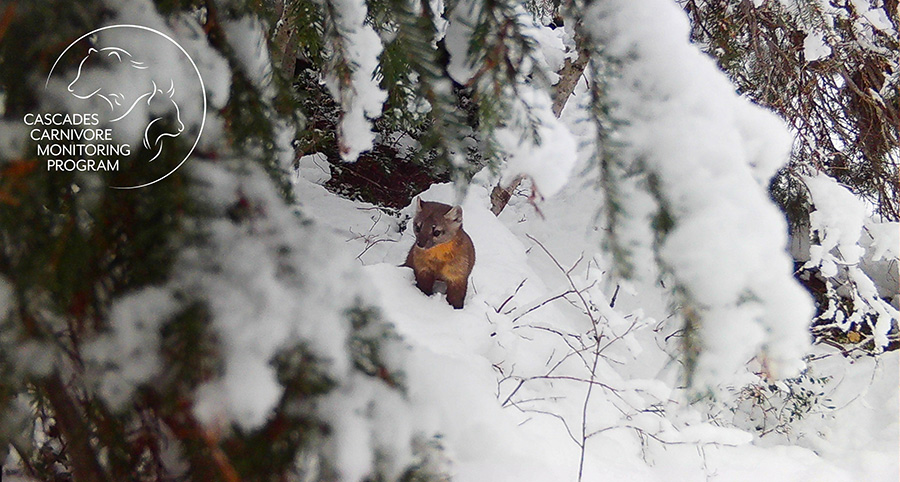
SEATTLE—The forests in the Cascades are alive and vibrant with fascinating wildlife…Images remotely snapped at research stations in the Cascades reveal detections of curious carnivores sniffing around and exploring. As scientists and volunteers diligently sort through1.5 million images of wildlife, preliminary detections reveal threatened or endangered wolverines, Canada lynx, gray wolves, Pacific fishers, Cascade red foxes and more.
Innovative and noninvasive survey stations make this field research possible. Over last summer and fall, field biologists with the collaborative Cascades Carnivore Monitoring Program deployed 135 on-trail camera stations and an additional 40 off-trail camera stations in the Cascades. The stations allow researchers to detect and monitor elusive species of conservation focus.
The off-trail cams were paired with an automated scent dispenser which Woodland Park Zoo initially co-created in 2015 in partnership with Microsoft Research and Idaho Fish and Game. The dispensers, further developed and now produced by the zoo, attract animals all winter and allow cameras to remain in place for a full year and survey wildlife throughout the harsh winters in the Cascades.
“The Cascades Carnivore Monitoring Program has completed another successful field season, thanks in large part to the tireless efforts of our partners. Long-term monitoring data are critical to conservation planning for climate-sensitive species such as wolverines and lynx, whose future will depend on our tracking their population status and better understanding their needs,” said Paula MacKay, Carnivore Conservation Specialist at Woodland Park Zoo.
The Cascades Carnivore Monitoring Program is co-led by Woodland Park Zoo and biologists at Washington State University, with participation from nearly three dozen partners from Washington and British Columbia including agencies, Indigenous groups, academic institutions, and other nonprofit organizations.
Learn more on our Cascades Carnivore Monitoring Program (CCMP) page
2025 research was generously supported by Seattle City Light and Wilburforce Foundation with in-kind support from The Inn at Mazama and Rite in the Rain.
