
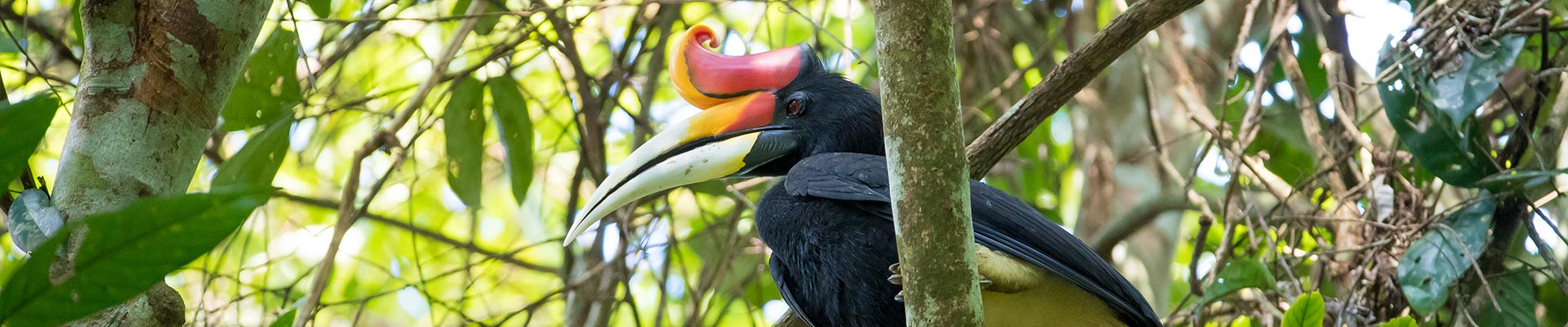
An Asian Hornbill AZA Saving Animals from Extinction (SAFE) Program
The hornbill research and conservation program was started in 1978 by Dr. Pilai Poonswad, to protect four species of hornbills at Khao Yai National Park in Thailand. In order to cover all 13 hornbill species found in Thailand, the research program was extended into two other study sites – Huai Kha Khaeng Wildlife Sanctuary in 1991, and Budo-Su-Ngai Padi National Park in 1994. The program’s goal is to sustain the conservation of hornbills and natural resources at the research sites.
Prior to 1994, poaching of hornbill chicks for the illegal pet trade was very common in the area surrounding Budo-Su-Ngai Padi National Park. Local villagers earned extra income by selling hornbill chicks as their regular monthly income was not sufficient to sustain their families.
To resolve the issue, Dr. Poonswad started to engage with poachers and illegal loggers to convince them to work with the Thailand Hornbill Project in research and education activities, in exchange for additional income. Because it was hard to find funding for the program, Dr. Poonswad came up with the idea of nest adoptions.
The nest adoption program began in 1997, and there are currently 40 local research assistants who observe and maintain over 140 nest trees in the Budo Su Ngai Padi area.
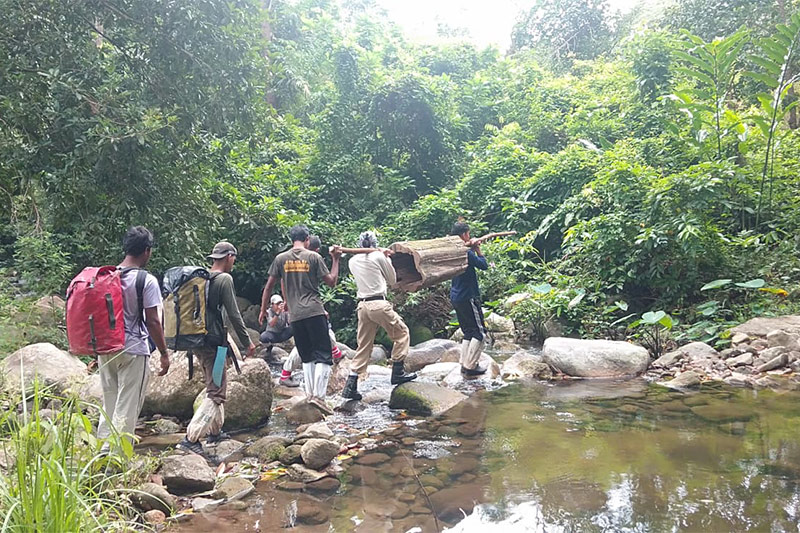
Currently, there are 40 local villagers working in research for the nest adoption program. There are over 100 nest adopters in greater Thailand and overseas supporting the program.
The local villagers have observed and protected 230 nests since 1994. Currently 100 nests are being observed, and 70% are actively used by hornbills. In 2004, the Hornbill Research Project began installing artificial nest boxes due to lack of natural nest holes and suitable nest trees for the hornbills. There are currently 17 artificial nest boxes in Budo-Su-Ngai Padi National Park. Villagers check, repair and improve about 20 hornbill nest cavities every year.
Full nest adoptions can be chosen, or donations of partial nest adoption costs can be made and every effort will be made to combine your donation with others to complete a full nest adoption so you receive a report on your nest.
Data is collected and analyzed from the local research assistants in the middle of the year after breeding season. For each nest adoption, the report will be collated in the middle of the following year and distributed. However, if there is a lot of field work and insufficient manpower, the report will be sent towards the end of the following year. When possible, we attempt to send the reports digitally to save costs.
Your check can be sent to Woodland Park Zoo, who acts as the US fiscal agent for the program. The address is:
Woodland Park Zoo Hornbill Nest Adoption
Attn: Finance
5500 Phinney Avenue N.
Seattle, WA 98103
On your check, please be sure you indicate it is to be used for the Hornbill Nest Adoption program. If checks come in without this designation, we won’t know what they’re intended for, so please don’t forget to indicate your donation intentions. Please include your contact information (including email address) so we can be sure to get you your nest report when available.
In Budo-Su-Ngai Padi National Park the Great, Rhinoceros and Bushy-crested hornbills have better success in breeding, but there are fewer nests of the Helmeted, Wreathed and White-crowned hornbills each year.
Photos courtesy of Hornbill Research Project
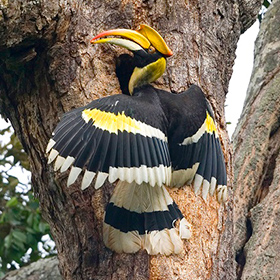
(Buceros bicornis)
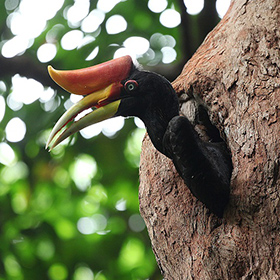
(Buceros rhinoceros)
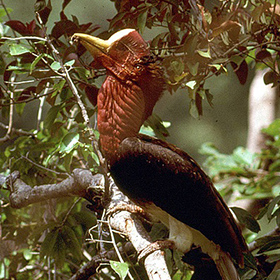
(Rhinoplax vigil)
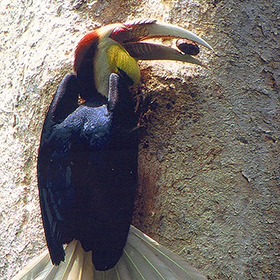
(Rhytideros undulates)
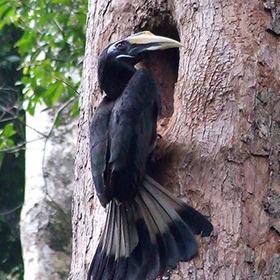
(Anorrhinus galeritus)
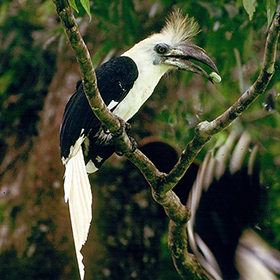
(Berenicornis comatus)
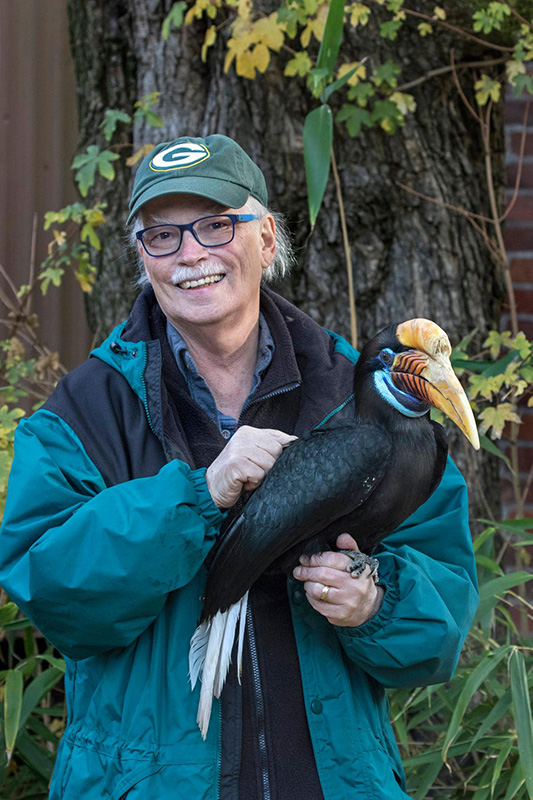
Woodland Park Zoo was lucky enough to have the ultimate hornbill expert on staff for 38 years. Eric Kowalczyk came to the zoo after completing his zoology degree at the University of Illinois, and a Master’s degree at Washington State University. Doing a job he often referred to as a “hobby and they paid me,” Eric fulfilled his lifelong passion for birds at the zoo.
He traveled to China for the International Crane Foundation early in his career, but didn’t develop a passion for hornbills until later. Eric was an active member and administrator of the IUCN Hornbill Specialist Group and began managing the hornbill nest adoption program. He was also the manager of the Association of Zoos and Aquariums (AZA) studbooks for several species of hornbills in North America, and created a “Friends of Hornbills” Facebook page.
After retiring in 2017, Eric started a weekly birding group at Sough Portage Bay, close to his home. The group became a close-knit group of friends who all learned to slow down, take time to enjoy nature and watch the birds. Remembrances can be made in Eric’s memory to the Hornbill Nest Adoption program. Please note on your donation that it is in memory of Eric Kowalczyk for the Hornbill Nest Adoption Program. Donations may be sent to the address listed above.
