
PRESS RELEASE / June 9, 2025
Class of 2025 turtles released to the wild
Zoo and partners saving endangered turtles one shell at a time
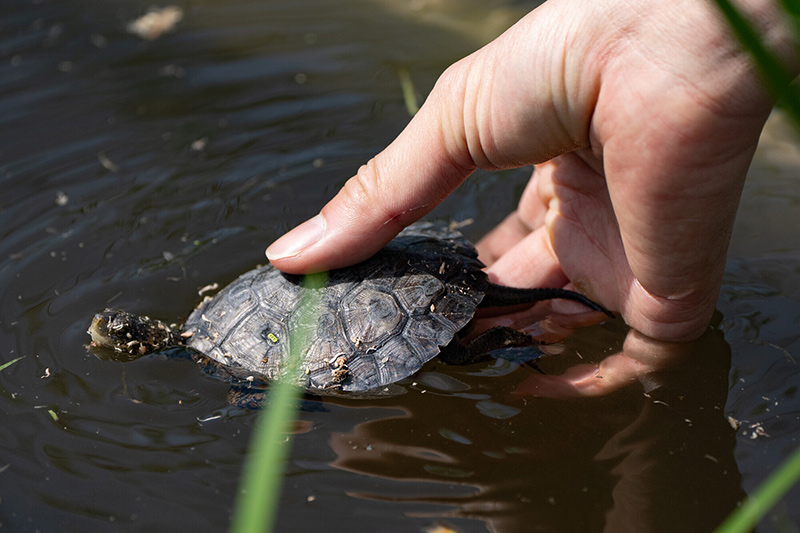
SEATTLE—One shell at a time, Woodland Park Zoo and partners are saving Washington state’s endangered western pond turtles. Over the weekend, the zoo and Washington Department of Wildlife held its commencement shell-emony and released 30 western pond turtles to a local protected site. The turtles are graduates of the head start class of 2025 as part of the Western Pond Turtle Recovery Project.
Every summer, Washington Department of Fish and Wildlife biologists retrieve the eggs from wild nests and bring them to the zoo where they are incubated and hatched. In the zoo’s Cathy Herzig Basecamp Northwest, the animal keepers raise the hatchlings for several months, feeding them an abundant, nutritious diet of fish, worms and other high protein items.
Pond turtles are teeny tiny when they hatch—about the size of a quarter. “From the time they hatch, these turtles are given a head start at life. Because we nourish them all year long, they grow at a much faster rate than wild turtle hatchlings,” said Erin Sullivan, an animal curator at Woodland Park Zoo. “By the following summer, the turtles have reached the sweet spot of 2 to 3 ounces, which is a suitable size to escape the mouths of invasive bullfrogs, which eat baby pond turtles. Now is an auspicious time to return them to the wild where they can continue to thrive.”
The 2025 class of the western pond turtles has graduated to the next chapter of their lives: living in protected wetlands where they can submerge in vegetation, basking on logs, swimming among mud banks, and dining on insects, amphibians and aquatic plants. The turtles will be monitored by WDFW biologists.
Now throughout the summer, zoo visitors can take a deeper dive into the pond turtle head start program through the zoo’s Turtle Head Start Experience offered Mondays through Thursdays, 2:00 p.m. in the Cathy Herzig Basecamp Northwest. Through a hands-on activity, young guests can learn and get hands on with the work the zoo’s animal keepers do in the Turtle Head Start Center to release young turtles into the wild every summer.
Western pond turtles (Actinemys marmorata) help to balance local wetland ecosystems. In 1990, only about 150 western pond turtles remained in two populations in the state of Washington and the species nearly became extinct. In 1991, Woodland Park Zoo and Washington Department of Fish and Wildlife joined forces to recover western pond turtles by initiating a head start program. In 1993, the state listed the western pond turtle as endangered. In 2000, Oregon Zoo joined the recovery team and, over the years, other nonprofits, government agencies and private partners have contributed to the multi-institutional conservation project.
Collaborative recovery efforts over the last three decades have resulted in more than 2,300 turtles being head started and self-sustaining populations re-established in two regions of the state: Puget Sound and the Columbia River Gorge. Surveys indicate that approximately 800 turtles—head started turtles and wild hatched turtles—survive and continue to thrive.
To help restore these rare pond turtles to their natural habitat, recovery workers take to the field each year. WDFW attaches transmitters to adult female western pond turtles and monitors the turtles every two hours during the nesting season to determine their nesting sites. The nests are protected with protective exclosures to help prevent predators from eating the eggs. In the early summer, eggs and hatchlings are gathered and transported to Woodland Park Zoo and Oregon Zoo where they can grow in safety.
Over the past decade, an emerging shell disease affecting more than 80 percent of the wild population threatens decades of recovery progress. Known to cause lesions in a turtle’s shell, severe cases can lead to lowered fitness and even death. Chicago’s Shedd Aquarium and the University of Illinois at Urbana-Champaign are looking at the disease from a microbial and pathological perspective to better understand its origin and the role environmental factors could play. The goal is to give young turtles a better chance at survival in the wild.
Slow, but steady
- Turtles have existed on Earth largely unchanged for 220 million years and survived the massive extinction that wiped out the dinosaurs. These ancient survivors are facing their own massive extinction crisis today with almost 50 percent of known turtle species listed as critically endangered or endangered. In fact, this incredibly diverse group of animals is going extinct faster than any other group of terrestrial vertebrates.
- The main threats to turtles are loss of suitable habitat and degradation, overhunting, competition with invasive species and the illegal pet trade. Other threats to the turtle population include invasive bullfrog predation and plants, and inappropriate ATV use.
- Western pond turtles can live to be 50 years old. They have a slow growth rate, taking 10 to 12 years to reach reproductive age. Few hatchlings make it to adulthood in the wild. Without intervention, these populations likely would not recover.
- From observing pond turtles foraging, biologists have found that western pond turtles swallow all their food in water and appear unable to swallow food in air!
Help save turtles and keep their local habitats clean and healthy
- Support Woodland Park Zoo and other organizations working to conserve endangered turtles.
- Never release unwanted home or classroom pets, animals, or plants into the wild, such as rivers, streams, lakes or stormwater ponds. Most unwanted pets will not survive in the wild and may suffer before death. If it does manage to survive, it may harm the environment.
- Reduce pollutants to turtle habitat by eliminating pesticides from your gardening practices.
- Dispose of litter properly.
- Call a rescue organization when you need to rehome aquatic pets.
- Volunteer to clean up local habitats.